
TeamChild is an NWCF Evergreen grant recipient, receiving $100,000 over three years. Evergreen grant recipients are longtime partners of NWCF that consistently demonstrate their high impact and effectiveness in ending the intergenerational cycle of trauma, abuse, and neglect.
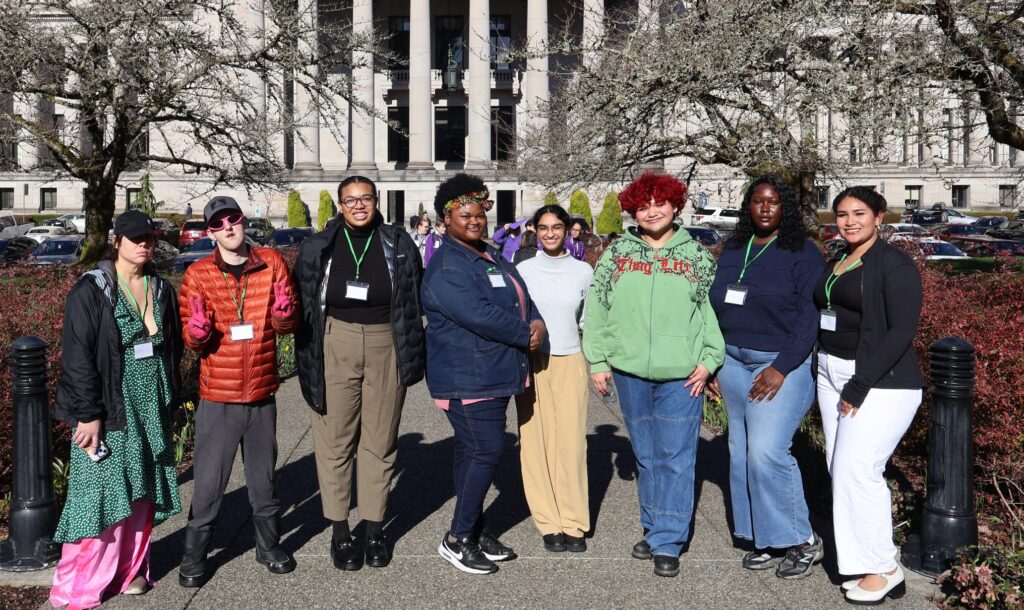
Members of the TeamChild Youth Action Coalition visiting Olympia to advocate for change in systems of care in Washington.
Sixteen-year-old Sarah1 had been navigating life largely on her own. Her mother had been absent for years, and her father died suddenly when she was 12. When her grandmother died four years later, Sarah lost both her last close family connection and her home. With nowhere else to go, she moved in with a friend’s family and struggled to get her basic needs met without a trusted adult to turn to.
A mentor through Communities in Schools, another NW Children’s Foundation agency partner, saw that Sarah needed more than social support and connected her with TeamChild.Since 1995, TeamChild has provided free legal advocacy to young people facing barriers to education, health care, housing, and other supports, helping young people navigate complex systems and build a more stable future. By listening to young people and championing their goals, TeamChild works alongside them to create pathways toward greater stability and independence.
For Sarah, that path was emancipation.
Her TeamChild attorney guided her through the process of becoming an emancipated minor and helped her find a path to independence.
“From the start, she called me and reassured me, which made me feel that everything was going to go well and smoothly,” said Sarah. “She also helped me to understand the process and walked me through the beginning steps.”
Sarah’s experience illustrates why alternatives to punitive responses matter. TeamChild was born when public defenders saw that young people were struggling because barriers to opportunity and stability often had legal obstacles. Today, that work remains critical as young people experiencing homelessness and other forms of instability can face increased contact with law enforcement and the juvenile justice system.2
Research shows that young people who become involved in the juvenile justice system are 92% more likely than their peers to have experienced trauma.3 Even short periods of juvenile detention can have lasting consequences. One study found that detention reduced the likelihood of high school graduation by 38% and increased the likelihood of adult arrest by 27%.4
When traditional social services or housing resources aren’t enough, TeamChild offers another path toward stability, using legal advocacy to help young people overcome barriers and pursue solutions that reflect their unique circumstances and goals.
“I am super grateful for the time and help I got from TeamChild,” said Sarah. “I don’t think I would be in the amazing spot I am now without their help.”
NW Children’s Foundation is proud to support TeamChild and our network of partners working together to ensure young people have options, advocates, and a path forward.
- Name change to protect client information ↩︎
- David Kroman, “In Seattle, 1 in 5 people booked into jail are homeless,” Crosscut, February 19, 2019, read published article. ↩︎
- Carly B. Dierkhising, Susan J. Ko, Briana Woods-Jaeger, Ernestine C. Briggs, Robert Lee, and Robert S. Pynoos, “Trauma Histories Among Justice-Involved Youth: Findings from the National Child Traumatic Stress Network,” European Journal of Psychotraumatology 4 (2013), https://doi.org/10.3402/ejpt.v4i0.20274 ↩︎
- E. Jason Baron, Brian Jacob, and Joseph P. Ryan, “Pretrial Juvenile Detention,” Journal of Public Economics 217 (2023): 104798. The study found that pretrial juvenile detention reduced the likelihood of high school graduation by 38% and increased the likelihood of adult arrest by 27% by age 19. The researchers also found significant negative effects from even short episodes of detention. Read the full study ↩︎